Explore Alki’s rich history at your own pace.
Click through each stop to discover the people, places, and stories that shaped the neighborhood.
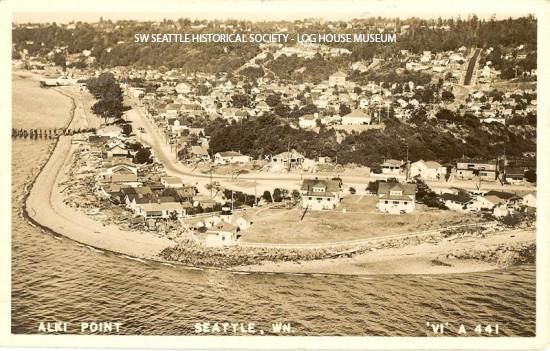
Historian Flo Lentz explained on the National Register of Historic Places Registration Form, “West Seattle referred only to the settlement along the northeast portion of the Duwamish Peninsula. The Alki neighborhood is located in the northwest portion of the peninsula. Despite the nearby development of the original West Seattle, Alki remained a remote, private summer recreation area. In the 1880s and 1890s, the original West Seattle settlement established itself as an industrial and residential outgrowth of downtown Seattle. The Williamson, Phillips, and Plummer sawmill opened in 1864 along present day Harbor Avenue SW, southeast of the head of the Duwamish River. A community sprang up around the mill. Initially named Freeport, the settlement took the name Milton by 1877 and then West Seattle in 1888. In 1893, a flour mill and public school were both under construction on the northeast corner of the peninsula. In 1899, King and Winge Shipyard, one of the most prolific ship building operations in Seattle’s history, was located on the southwest portion of Duwamish Head. In 1902, West Seattle was officially incorporated as a municipality. Peninsula communities, including Alki remained separate and independent until Seattle annexed them all as a group in 1907 under the name West Seattle.
In contrast, the Alki neighborhood remained quiet and sparsely visited. The sandy beach at Alki beckoned to swimmers and beachcombers. Alki beaches became popular summer vacation spots for city dwellers seeking rustic living. The privately run Coney Island Baths opened in 1899, west of Duwamish Head. In 1901, Albert A. Smith built the Stockade Hotel near the present intersection of 63rd Avenue SW and Alki Avenue SW. Alki Point had at least one other known beachfront resort named Rose Lodge. A public bathing beach was opened in 1901 and a natatorium in 1905. By 1905, photographs show canvas tents, private cabins, and vacation homes dotting the landscape. Historian Flo Lentz states that in July 1905 the local newspaper listed more than seventy-five beach cottages along Alki Avenue from the ferry landing to the natatorium. An amusement park, Luna Park, opened in 1907. Despite the summer visitors, there were few, if any year-round residents. However, Flo Lentz notes, the Alki neighborhood quickly evolved, “with permanent residences, commercial structures, a public school, a play field with golf links, and a church.”
All helping the growth in West Seattle and Alki were different methods of traveling to the area in the late nineteenth and early twentieth centuries. Yet, these modes of transportation were not perfect and still made traveling permanently from Alki to Seattle difficult. Beginning in 1888, ferries crossed Elliott Bay, connecting downtown Seattle and West Seattle. Small steamships, collectively known as the Mosquito Fleet, also transported passengers to docks at Alki Beach and other points on the Duwamish Peninsula. These ferries, however, were only rafts of logs held together by ropes and propelled by men with pine-poles or they were allowed to drift with the current. According to Sophia Frye Bass, “The roads in West Seattle were seldom used, rough, and full of chunk holes. The easiest ways of travel were by canoe, sail boat, or plodding over wet sands when the tide was out.” In 1890, the Seattle Terminal Railway and Elevator Company built a trestle to the peninsula from the present Port of Seattle, bridging the south end of the Elliott Bay tidal flats. In later years, with people coming to the beach, the roads became better and a plank road boulevard was built along the shore over the water. In 1907, an electric streetcar began service from Seattle to West Seattle. All this new transportation brought a flood of visitors to Alki and transformed the beach to a busy resort area in the summers.
After the arrival of the streetcar service, Alki continued to develop as a tourist destination and became a year-round community. Public recreational and civic facilities anchored the neighborhood. In 1910 the City of Seattle erected the Alki Bathing Pavilion and was opened in 1911. It served as a community gathering place and sports venue. A bandstand was completed in 1912 along Alki Beach Park. Commerce and new residents blossomed along present day Alki Avenue SW. Today, the Alki neighborhood is defined by continued recreational use of the waterfront.
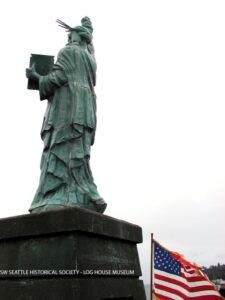
This self-guided walking tour of Alki represents some of the most historically significant and prominent sites. Beginning and ending at the Alki Homestead, this tour is also meant to display the importance of historic preservation and its continuation thereof. This walking tour goes along with a grant funded by 4Culture for the preservation of the Alki Homestead. The Alki Homestead serves as the bookends of the tour with the Alki Statue of Liberty, the Founders Monument, the Denny Home Site, Doc Maynard’s Home, and the Log House Museum as our other main spots. Included is also a stop at the Sunfish Restaurant to appreciate the mural of Kalaloch, a beach on the farthest northwestern portion of the Olympic Peninsula, to learn more about the natural history and discovery of the Juan de Fuca Strait and ultimately Puget Sound, as you also appreciate the views of the beach and the growth that is the current Alki neighborhood.
The tour is a distance of .88 miles and is located on paved walkways with some crossing of the street. The street crossings were located at pedestrian crosswalks when possible but otherwise are still located in places where street crossing is safest. When listening to the tour, the length is 38.46 minutes.
For the sake of continuity, the Duwamish Chief’s name will be Seattle throughout, but would like to point out that different spellings in history have him as Seeathl and Seathl.
Bass, Sophie Frye Pig-Tail Days in Old Seattle Metropolitan Press, Portland: 1937.
National Register of Historic Places Registration Form OMB No. 1024-0018. United States Department of the Interior National Park Service www.dahp.wa.gov/sites/default/files/WA_King_County_FirLodge_FINAL.pdf